
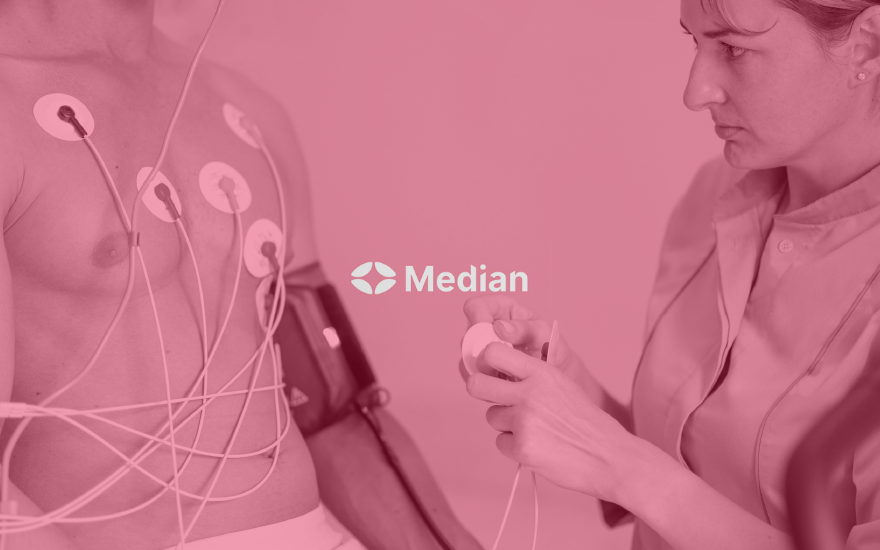
Stress testing (shortened to ST) is a type of electrocardiographic examination conducted under physical exertion. It helps identify hidden heart pathologies, including coronary insufficiency, angina, and other cardiac issues. This medical test is performed on a stationary bicycle and is one of the exercise ECG tests, similar to the treadmill test conducted on a running track. During stress testing, the patient pedals a stationary bike while a specialist records heart activity readings.
You can undergo an exercise ECG test at the Median Clinic. We have all the necessary modern equipment for precise and safe testing. You can easily book an appointment with a cardiologist online through our website.
Service Prices at Median Clinic
- Stress Testing — 1200 UAH
- Cardiologist Consultation — 880 UAH
- Expert Cardiologist Consultation (Professor) — 1800 UAH
- Expert Cardiologist Consultation (Professor, advanced level) — 2200 UAH
Our Services
- Cardiologist appointments
- ECG
- Heart ultrasound (EchoCG)
- Holter ECG monitoring
- Arrhythmia treatment
- Ischemic heart disease treatment
- Angina treatment
When is Stress Testing Needed?
This type of examination, like the treadmill test, is necessary when a patient has complaints about their cardiovascular system but a standard ECG shows no abnormalities. Indications for this test include:
- Complaints of occasional chest pain with a normal cardiogram;
- Symptoms of angina not confirmed through standard diagnostic procedures;
- Detected lipid metabolism problems without pronounced ischemic heart disease.
Treadmill tests and stress tests are also recommended when there are no cardiovascular complaints, but a standard ECG reveals irregularities in heart function.
Additionally, an exercise ECG is advised in the following cases:
- To monitor health dynamics during treatment for various cardiovascular diseases. Results obtained during the test are useful for adjusting the chosen therapeutic strategy;
- For individuals actively involved in sports and fitness (this test is routinely conducted for professional athletes);
- For certain professional activities. This type of heart check is recommended for professional drivers, pilots, divers, etc.;
- For preventive purposes.
Preparation and Conduct of Stress Testing
Exercise ECG testing requires minimal preparation:
- Patients should wear sports clothing and shoes;
- Discontinue medication one day before the test (this should be agreed upon with the treating doctor);
- Avoid eating 2-3 hours before the test;
- Refrain from smoking, alcohol, and caffeinated beverages 12 hours before the procedure.
The exercise ECG test is conducted as follows:
- Sensors are attached to the patient’s chest, and a cuff is placed on the arm to measure blood pressure;
- The patient starts pedaling the stationary bike;
- The pedaling begins at a slow pace and gradually accelerates to reach the desired heart rate;
- The doctor records the ECG readings;
- After completing the exercise, readings continue to be recorded for 10 minutes.
The treadmill test follows a similar procedure: the patient starts walking on a treadmill and eventually transitions to running.
Contraindications for Stress Testing
Absolute contraindications for exercise ECG include:
- Low blood pressure with frequent fainting;
- Acute myocardial infarction;
- Renal and hepatic failure or other severe conditions;
- Inflammatory heart tissue damage;
- Mental disorders preventing the patient from understanding the procedure;
- Aneurysm;
- Pulmonary artery blockage.
Relative contraindications include:
- Diabetes;
- Late-term pregnancy;
- Presence of artificial valves;
- Hepatitis;
- HIV;
- Low hemoglobin levels;
- Oncology.
In these cases, testing should be postponed until recovery and/or ensuring the test will not worsen the patient’s condition.
This procedure is also not recommended for elderly individuals over 70 or minors.
Stress Test Results
As with a standard ECG, the main outcome of the examination is the collection and interpretation of heart activity data. If the readings are within acceptable norms (negative test), the cardiologist at the Median Clinic concludes there are no hidden cardiovascular issues.
In the case of a positive test, where objective signs of ischemia appear during the examination, the conclusion is made about the presence of pathologies, and all necessary measures are taken to treat or manage the condition. In some cases, the results of stress testing and treadmill tests may be inconclusive or non-informative.
Make an appointment with a doctor for an ECG under instructions